How to Choose the Right AI Tool for the Job: ChatGPT vs Copilot vs Claude vs Gemini
Artificial intelligence (AI) has quickly moved from a technology experiment to a workplace reality. Employees are using AI to draft emails, summarize meetings, analyze documents, conduct research, generate ideas, and automate repetitive tasks.
As organizations explore AI adoption, one question comes up again and again: Which AI tool should we use?
Selecting “The Best” AI Tool for Your Team
Should we use ChatGPT? Microsoft Copilot? Google Gemini? Claude?
The challenge is that many organizations jump straight to comparing products before understanding what problem they are trying to solve. The result is often confusion, fragmented adoption, and technology decisions driven by hype rather than business needs.
The reality is that all four tools are powerful. The better question isn't which one is best. It's which one is best suited to the work you're trying to accomplish.
Before Comparing Tools, Understand the AI Landscape
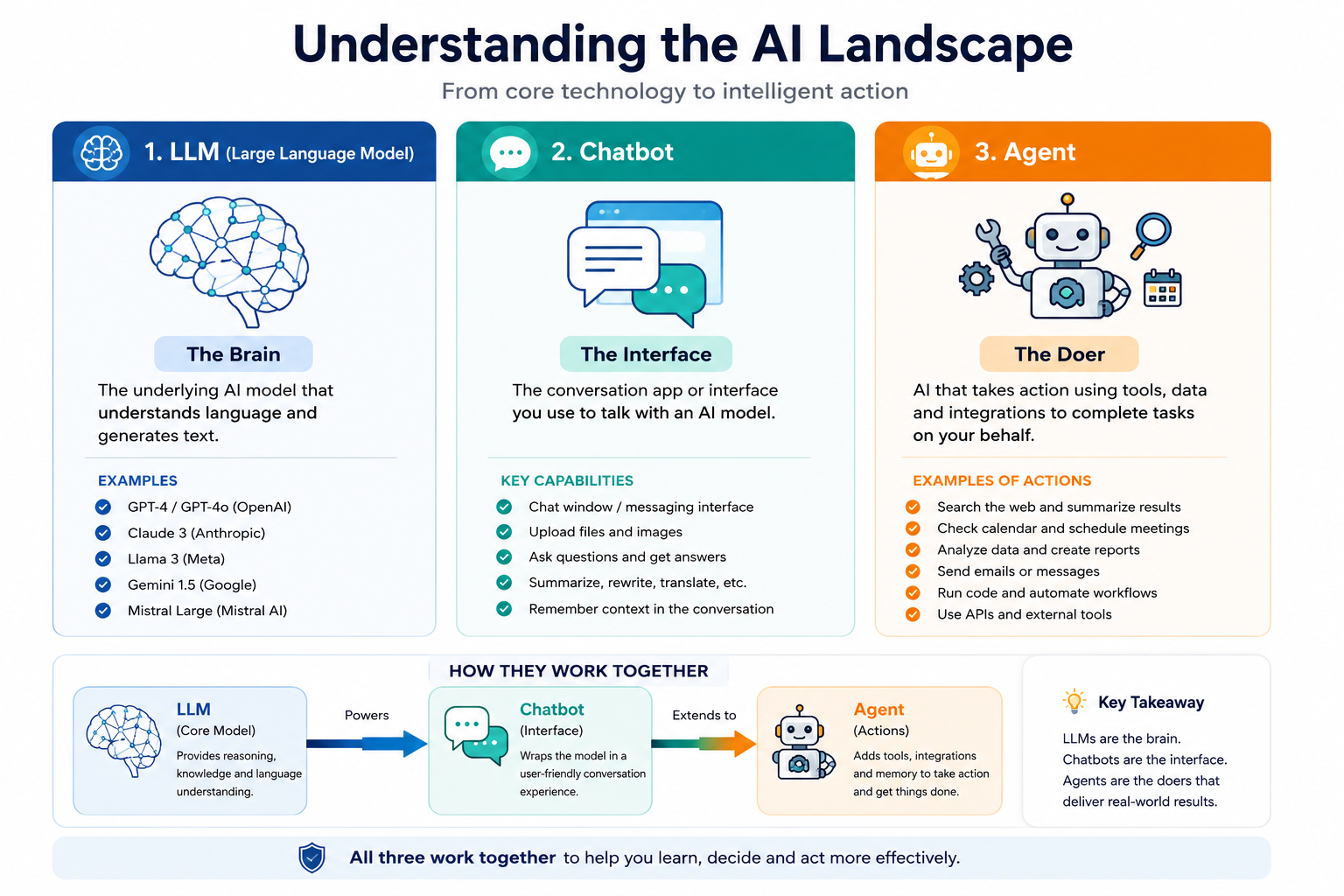
One of the biggest sources of confusion in AI conversations is that people often use terms like AI, chatbot, large language model, application, and agent interchangeably. They are not the same thing.
A useful way to think about modern AI is in layers.
Large Language Models (LLMs): Large Language Models, or LLMs, are the engines that power today's AI tools. Models such as GPT-4, Claude, and Gemini have been trained on massive amounts of data and are capable of generating responses, analyzing information, reasoning through problems, and creating content. Most users never interact directly with an LLM. Instead, they interact with tools built on top of them.
Chatbots: Chatbots are the interfaces most people are familiar with. ChatGPT, Claude, Gemini, and Copilot allow users to interact with AI through conversation. This is where most organizations begin their AI journey. Employees ask questions, summarize documents, generate content, or brainstorm ideas through a simple chat interface.
AI Agents: AI agents represent the next phase of AI adoption. Unlike chatbots, which primarily respond to prompts, agents can take action. They can gather information, interact with systems, complete multi-step tasks, move data between platforms, schedule activities, and automate business processes. While many organizations are still exploring chatbots, AI agents are increasingly becoming the focus of more advanced AI deployments.
Understanding these distinctions is important because organizations are often trying to solve very different problems with very different technologies.
A Practical Guide to the Big Four AI Tools
ChatGPT: ChatGPT remains the most widely adopted AI tool and, for many users, the most versatile. It performs particularly well for:
Writing and editing
Brainstorming and ideation
Meeting summaries
Research support
General productivity tasks
For organizations looking for a strong all-purpose AI assistant, ChatGPT is often the easiest place to start.
Claude: Claude has built a reputation for handling large volumes of information and more complex analytical tasks. It is often a strong choice for:
Long document analysis
Research and synthesis
Policy reviews
Regulatory content
Complex writing projects
Many organizations find Claude particularly effective when accuracy, nuance, and context are critical.
Google Gemini: Gemini is Google's AI platform and is tightly integrated with Google Workspace. It is particularly useful for organizations using:
Gmail
Google Docs
Google Sheets
Google Drive
Gemini also has strong multimodal capabilities, making it useful when working across text, images, and other forms of content.
Microsoft Copilot: Microsoft Copilot is built into the Microsoft 365 ecosystem, making it attractive for organizations already using Outlook, Teams, Word, Excel, PowerPoint, and SharePoint. Common use cases include:
Email drafting
Meeting recaps
Document creation
Presentation development
Working with organizational content stored in Microsoft systems
For organizations heavily invested in Microsoft, Copilot offers the advantage of working directly within existing workflows.
The Real Decision Isn't ChatGPT vs Claude
One of the biggest mistakes organizations make is treating AI adoption as a software selection exercise. In reality, the more important decision is how AI will be deployed across the organization.
While tools matter, they are only one part of the equation. Organizations must also decide how employees will access AI and whether a standardized or specialized approach makes the most sense for their environment.
Broadly speaking, most organizations adopt one of two AI deployment strategies: a single platform for all employees or a role-based approach that matches tools to specific job functions.
Option 1: One Tool for Everyone
Option 2: Role-Based AI Toolkits
Some organizations standardize on a single platform and provide it to every employee. The advantages include:
Simpler governance
Easier training
Consistent user experience
Lower administrative complexity
The trade-off is that a single tool may not be the best fit for every role.
Other organizations take a role-based approach, selecting tools based on specific needs. For example:
Executives and administrators may benefit from Copilot's integration with Microsoft 365.
Researchers and analysts may prefer Claude's ability to process large documents.
Creative teams may leverage Gemini's multimodal capabilities.
Developers may use GitHub Copilot, Claude, or ChatGPT for coding support.
This approach often increases adoption and productivity because employees can use the tools that best align with their work. However, it also introduces additional complexity around governance, licensing, support, and training.
There is no universally correct answer. The right approach depends on your organization's size, technology ecosystem, budget, risk tolerance, and business objectives.
What Organizations Should Focus on Next
The organizations seeing the greatest value from AI are not necessarily the ones with the most advanced tools. They are the ones that are investing in the foundations required for successful adoption.
Build AI Literacy: Employees need a basic understanding of how AI works, where it adds value, and where human judgment remains essential. Without foundational knowledge, organizations often experience inconsistent results and unrealistic expectations.
Establish Clear Policies: Employees need clear guidance on what information can be shared with AI tools, how outputs should be validated, and what safeguards are required when working with confidential or sensitive information.
Develop Leadership Capability: AI adoption is as much a leadership challenge as it is a technology challenge. Leaders need to understand how AI impacts productivity, decision-making, workflows, and organizational capability in order to make informed decisions about deployment.
Create Internal Feedback Loops: Many employees are already experimenting with AI on their own. Organizations that create mechanisms for sharing lessons learned, successful use cases, and emerging challenges tend to accelerate adoption while reducing risk.
Choosing with Purpose
As AI capabilities continue to evolve, organizations will have more tools, more features, and more choices than ever before. The challenge won't be keeping up with the latest platform. It will be understanding where AI can create meaningful value and making intentional decisions about how it is used.
Whether you're exploring ChatGPT, Copilot, Gemini, Claude, or the next generation of AI tools, the goal remains the same: match the right technology to the right task, equip people with the skills to use it effectively, and create systems that support responsible adoption.
The organizations that succeed with AI won't necessarily be the first to adopt every new tool. They'll be the ones that develop a clear strategy, build internal capability, and focus on solving real business problems.
If you’d like to take action and support your organization, connect with us for a conversation.